
Driving in Florida: The complete guide for UK visitors
You are here: Home → Guides → Driving in Florida
Driving in Florida for the first time feels like a big step. Most UK visitors worry about the wrong side of the road, wide highways, and rules they have never heard of. The reality is better than the worry. Florida is one of the most tourist-friendly places in the world for driving in a hire car. Roads are wide and well-signed. Cars are almost all automatics. Rules are clear once you know them.
This guide is written by Rob Gardner, co-founder of Smarter Car Hire Florida, a UK-based Florida car hire broker exclusively serving British holidaymakers. Smarter Car Hire is partnered with major Florida car hire providers including Hertz, Alamo, and SIXT. Rob has been visiting and driving hire cars in Florida since 1992. This guide is built on that experience. It is not a general travel guide. It is written specifically for UK drivers.
What this guide covers
This guide explains UK licence rules for driving in Florida, how to adapt to right-hand traffic, and the road laws UK drivers most often get wrong. It also covers toll roads, school bus laws, child seat rules, speed cameras, fuel tips, parking, and what to do in a Florida afternoon storm. Every section draws on first hand Florida driving experience.
UK Licence Requirements for Driving in Florida
Your standard UK photocard is your key document. An IDP is not a legal requirement for UK photocard holders driving in Florida. Some drivers prefer to carry one for peace of mind. An IDP costs £5.50 and can be purchased from participating PayPoint locations.
Photocard vs. Paper Licences for Florida Car Hire
If you hold the old-style paper licence, get an IDP before you travel. The paper licence alone is not enough. Rental companies may refuse to hand over the vehicle without it.
Age limits and driver fees
The lead driver must be at least 21 years old. They must have held a full UK licence for at least 12 months in a row. Drivers aged 21 to 24 may face a young driver fee at the desk, paid to the rental company at collection. Drivers aged 70 and over may face a senior driver fee under some supplier policies. Whatever you pay at the desk is separate from your booking itself; if you booked through Smarter Car Hire Florida, you'll already know about our zero deposit car hire. Keep in mind that debit card rules at the desk vary considerably depending on which supplier you've been allocated.
For licence and age requirements by airport, see our airport guides for Orlando MCO, Miami Airport, Tampa Airport, Fort Lauderdale, and Melbourne International.
Driving on the right: What to expect
For UK drivers with little or no prior right-hand driving, it will feel strange at first. This is normal. Take things at your own pace while staying aware of other road users. Hire cars in Florida are almost all auto. This removes one concern straight away. No gear stick means one less thing to think about. You can focus on being on the right side of the road.
Rob's single most important rule
After 30 years of driving in Florida, Rob's advice is this: as the driver, you must always be the one closest to the centreline. Say this before every journey, especially at the start of the trip when UK habits are strongest.
When UK instincts return
Even experienced Florida drivers slip back into UK instincts. Rob saw this often on early trips. After reversing off a villa drive, he would move forward and drift towards the left. He would catch it quickly. The fix is always the same: slow down a little and read your surroundings. Speed removes thinking time.
Navigating roundabouts
Roundabouts in Florida are rare but they exist. Give yourself extra time when you find one. The urge to enter on the left will feel strong. Slow down and get through it safely.
Vehicle setup before driving away
Spend a few minutes in the car before leaving the rental garage. Set the headlights to auto. Find the wipers. Adjust the mirrors. All hire cars differ. Knowing where things are removes one more item to think about on the road.
Driving in Florida - road rules UK visitors get wrong most often
Some Florida rules differ greatly from the UK. These are the ones that catch UK drivers out most. For the full set, including the Move Over law and the open container rule covered below, our Florida driving laws guide goes through each one in more depth.
Turning Right on Red Lights in Florida
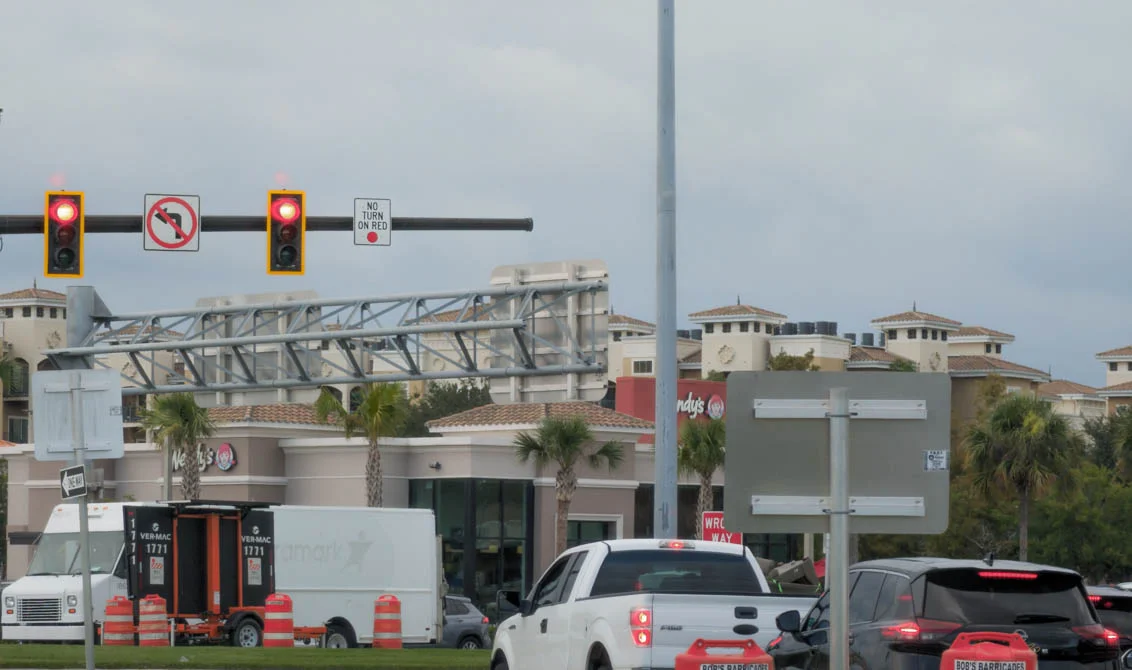
Florida law allows drivers to turn right at a red light when no sign forbids it. You must come to a full stop first, check the way is clear, and then turn. Rob found this hard to accept at first. Crossing that line with a red light showing felt deeply wrong. Do not take offence if a local driver beeps at you. They are saying it is fine to go. If a sign says No Turn on Red, it is posted clearly at the side or above the lights.
The 4-way stop junction
Florida uses 4-way stops at many junctions, a rule with no direct UK match. The first vehicle to stop is the first to go. If two cars arrive at the same moment, the driver on the right has priority. A key point: you must come to a full stop. A rolling stop is an offence in Florida.
Undertaking on multi-lane highways
On multi-lane Florida highways, passing on the right is legal and common. After three decades of driving in Florida, Rob still finds this the hardest habit to accept. It goes against all a UK driver has been taught. On busy roads like the I-4 or Florida Turnpike, traffic moves on both sides. Check blind spots often when changing lanes.
Lane merges and U-turns
On larger highways, lanes sometimes merge with very little warning. When you see a merge ahead, slow down and assess the gap. Merge at the same speed as the cars already in that lane.
U-turns are legal at most Florida junctions unless a sign says otherwise. If you miss a turn, go to the next light and come back. A calm correction is far safer than a rushed one.
The Move Over law (Florida Statute 316.126)
Florida Statute 316.126 — updated January 2025, requires you to move over one full lane for any vehicle on the shoulder with hazard lights, flares, or warning signs. This covers all stopped vehicles, not just emergency services. If moving over is not safe, cut your speed by 20 mph below the posted limit.
Speed limits and red light cameras
Speed limits in Florida work much like the UK. Signs are clearly visible at the roadside and on overhead gantries. Some traffic light systems use red light cameras, signs warn drivers before the junction. Speed cameras are in use across Florida, and locations change. Rob's advice is the same across all 30 years: monitor the speed limit and drive to it, not above it. Florida Highway Safety and Motor Vehicles publishes current road safety guidance.
Drink driving and open container laws
Florida's drink drive limit is 0.08 per cent blood alcohol, the same as the UK adult limit. However, Florida adds a rule that surprises many UK visitors. Under Florida Statute 316.1936, having any open drink in the passenger area is a non-criminal moving traffic violation (unless accompanied by a DUI, then it is a criminal offence). Passengers are included. In the UK, passengers can drink in a private car. In Florida, this is not allowed. Alcohol must travel in the boot only.
For drivers under 21, Florida applies near-zero tolerance. The limit is just 0.02 percent. All people in the car must wear a seat belt. Every seat.
School bus laws: What UK drivers must know
This section covers one of the most strictly enforced rules for UK visitors driving in Florida.
Stopping requirements for school buses
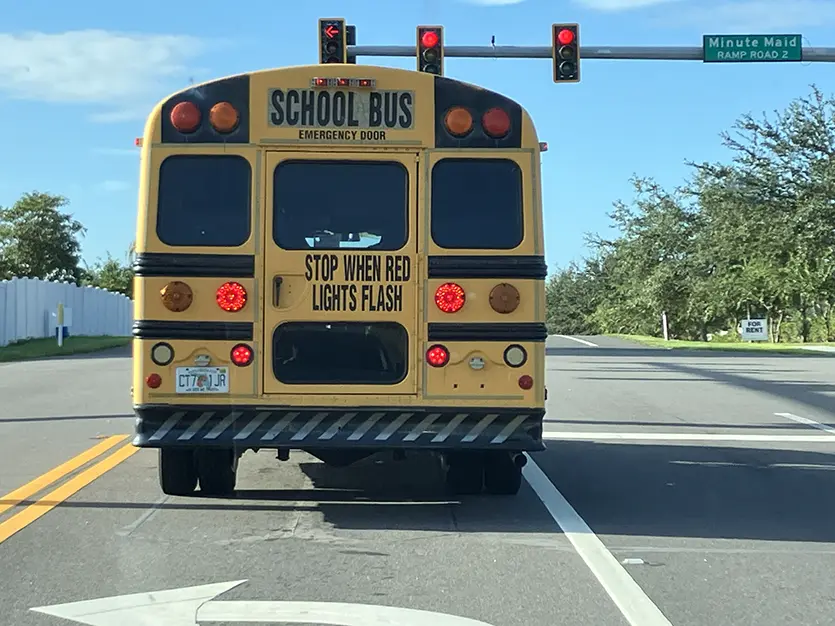
When a school bus displays flashing red lights and extends its stop arm, all traffic must stop. On a two-lane road, or any multi-lane road without a raised barrier, both directions must stop. You may only go on if a raised concrete barrier or a grass gap of at least five feet divides you from the bus. Paint on the road does not count as a divider. If in any doubt, stop.
Camera enforcement and fines
Florida counties are fitting cameras to school buses under Florida Statutes 316.173 and 318.18(5). Active programmes include Duval County, Lee County (Fort Myers), Hillsborough County, and Miami-Dade. Fines are $225 per occurrence. Cameras record both directions Fines arrive by post, there is no on-the-spot stop.
Rob's advice is simple: when you see a school bus slowing ahead, slow with it. Give yourself time. If the red lights are on, stop.
Practical advice for Florida road trips
Toll roads and cashless expressways
Florida roads use cashless tolling. Most toll points have no cash option. If you drive through a toll without a pass, the camera records your plate, charges the rental company, and they pass it to you with a fee on top.
Florida's expressways are cashless with overhead gantries. For transponders, rental fees, and correct rates, read our Florida toll roads guide for UK hire car drivers.
The Florida Visitor Toll Pass suits most UK visitors flying into Orlando. Download the app before you travel and collect the physical hang-tag from the vending machines at MCO. SunPass is another option that is often cheaper than the rental company's own toll product. Decline the rental company's toll programme at the desk to avoid double billing.
What to do if you go through a toll without a pass
This question appears on Florida travel forums often. The charge goes to the rental company, who add their admin fee and pass both costs to you. Multiple tolls mean multiple fees. If this happens, contact Smarter Car Hire Florida on 01325 808123. The best fix is a plan made before you collect the car.
Travel distances and live navigation
Florida looks compact on a map. It is not. UK visitors often underestimate distances when driving in Florida for the first time. Orlando to Miami is around 240 miles and takes four hours without stops. Getting to the Florida Keys from Orlando covers over 300 miles, allow five to six hours. Getting from the Everglades to Orlando takes three to four hours. Roads around Orlando, Tampa, and Miami can get very busy. Theme park areas create heavy traffic at peak times. If you need to be somewhere at a set time, add extra time. Rob does this on every trip.
Use a live traffic app. Rob recommends Waze for Florida highway driving. It gives early warning of stopped traffic and clear lane guidance ahead of exits. Download offline maps before you fly in case signal drops in remote areas.
The Orlando to Florida Keys drive via US-1 is one of the great road trip routes in the world. The Overseas Highway crosses 42 bridges over open water. Give it a full day and stop at Marathon or Islamorada. Do not rush it.
The Everglades drive on I-75 from Miami to Naples is another route most tourists never see. Allow half a day. Plan fuel stops , petrol stations are further apart in rural Florida than UK drivers expect.
Paying for fuel at the pump (the zip code trick)
At Florida petrol stations, the pump asks for a five-digit zip code before it gives fuel. UK cards have no zip codes. This catches UK drivers off guard often when driving in Florida for the first time. Take the numbers from your UK postcode and add two zeros. For a postcode of SW1 1AA, enter 11000. When that fails, try 99999. When neither works, go inside the station and tell the cashier how much you want to spend and on which pump. Many modern US pumps now accept contactless cards and Apple Pay or Google Pay without a zip code at all.
Parking rules and towing risks
Florida vehicles display only one number plate at the rear. When parking, that plate must be visible to law enforcement. Reversing into a bay or pulling through to the bay in front can hide the plate. This may result in the vehicle being towed away for a ticket being issued.
Towing in Florida is strictly enforced. If you park in a tow zone, your car is removed and you pay to release it. Rob has seen this happen in Celebration, Orlando, where towing firms operate actively. Always check the signage before you walk away.
Navigating Florida afternoon summer storms
Florida summer afternoons bring heavy storms. Most arrive around 4pm and are intense. Visibility can drop fast on highways and in built-up areas. Florida law permits the use of hazard lights while driving in heavy rain, but only on roads with a speed limit of 55 mph or above, this rule came into effect in July 2021. Hazard lights do not replace headlights. Use both in low visibility conditions.
If conditions become extreme, pull off the road. A car park, a petrol station, or a rest area will do. Florida storms pass quickly, a 20-minute wait is far safer than driving in near-zero visibility. Setting headlights to auto before leaving the garage means they come on when needed.
Child car seat rules: UK vs. US compliance
Florida law requires all children aged 5 and under to use a federally approved child seat. This rule applies to UK families driving in Florida just as it does to Florida residents. The key issue for UK parents is certification. Florida requires seats certified to FMVSS 213, the US federal standard. Most UK seats carry ECE R44 or ECE R129 instead. These are strong standards but they do not satisfy Florida law. Check the label on your seat before you fly. If it does not say FMVSS 213, it does not meet Florida's legal rule, and may invalidate your Florida car hire insurance.
As a UK holidaymaker, Your three options are hire a child car seat from the rental company at the desk. Alternatively, buy a compliant seat on arrival from Target or Walmart from around $30. Or bring your own from the UK, but only if it carries FMVSS 213 certification. ISOFIX connectors work with LATCH anchors in most US hire cars. Check that the seating position has LATCH anchors, check your seat manual, and always use the top tether for forward-facing seats.
Florida law ends the child seat rule at age 6. Safety experts and FLHSMV both advise keeping children in a booster until they reach 135 to 145 cm — often around age 10. The law sets a minimum. Your judgement as a parent sets the standard.
For the full guide including the supplier hire price comparison, read our Florida child seat laws guide for UK holidaymakers.
Disabled parking with a UK Blue Badge
If you use a UK Blue Badge, Florida recognises your permit for disabled parking when it displays the International Symbol of Accessibility. Before your trip, read our guide to using a UK Blue Badge for disabled parking in Florida for parking rights at major venues including Disney World and Universal, display requirements in hire cars, and what to do if you receive a parking citation.
Theme park parking tip
Disney and Universal car parks hold thousands of vehicles. After a full day in the park, you will not remember where you left your car. Take a photo of your row number and level before you walk away. It takes five seconds and saves a long, tired search.
Ready to book your Florida hire car? Every Smarter Car Hire Florida booking includes full insurance, zero deposit, and SmartTrack automatic price tracking as standard.
Driving in Florida FAQs
-
Yes, and for most UK holidaymakers, it turns out to be far easier than they expected. Roads are wide, signs are large and clear, speed limits are posted in mph, and hire cars are almost always automatic. The main adjustment is driving on the right, which the majority of visitors find natural within a day or two.
That said, Florida is a busy state with high traffic volumes, and a handful of local rules catch UK drivers off guard. Before you collect your car, it is worth knowing:
Right turn on red — unless a sign says otherwise, you may turn right at a red light after a full stop and yielding to traffic. Locals expect you to do this; sitting still will draw horns.
The Move Over law — when emergency, police, or roadside assistance vehicles are stopped on the hard shoulder, you must move one lane away. This is actively enforced.
Four-way stops — common on Florida roads with no UK equivalent. First to stop is first to go.
School bus rules — all traffic in both directions must stop when a school bus displays flashing red lights and an extended stop arm.
Take the first day or two at your own pace, use a live navigation app to stay ahead of lane changes on multi-lane roads, and read our full Florida driving guide before you travel.
-
Almost all toll roads in Florida are now cashless, meaning there are no staffed booths to pay at, your vehicle's number plate is read automatically as you pass through. If your hire car has a toll transponder fitted, the charge is recorded electronically. If not, the toll authority issues a plate-read invoice to the rental company, who passes the charge on to you.
In either case, you will pay the toll itself plus an administration or processing fee set by your rental provider. These fees vary by company and are separate from the toll amount, they cover the cost of the rental company receiving, matching, and processing the charge against your booking. They are charged to the payment card you used at collection.
The key thing to understand is that the administration fee can exceed the toll itself, and it applies per transaction or per usage day depending on your provider. If you are planning to use toll roads, which on many Florida routes is difficult to avoid, it is worth checking your rental agreement for the specific fee structure before you travel, or speaking to us before you book.
-
No. Florida law requires a crash-tested, federally approved child restraint device under Florida Statute §316.613. In practice this means any seat used must comply with Federal Motor Vehicle Safety Standard 213 (FMVSS 213), the US federal certification standard. UK seats are certified to European standards, either ECE R44 or the newer UN R129 (i-Size), which are separate standards and do not satisfy the Florida legal requirement, regardless of how safe the seat is in other respects.
Check the label on your seat before you travel. If it shows ECE R44 or R129 and no FMVSS 213 mark, it cannot legally be used in Florida.
The practical solution is to add a child seat to your car hire booking at the point of collection. Seats provided by hire companies in Florida will meet the required standard.
For full details on age and weight requirements, booster seat rules, and what to ask when booking, read our Florida child seat laws guide.
-
Yes. Under Florida Statute §316.172, all traffic in both directions must stop when a school bus displays flashing red lights and an extended stop arm. You must remain stopped until the stop arm is withdrawn and the red lights go off. If you're travelling with young children, the same chapter of Florida law also sets out strict requirements for child car seats, which catch out a similar number of UK families.
The only exception is if you are travelling in the opposite direction on a road divided by a raised physical barrier or an unpaved space of at least five feet A painted line or a turn lane does not qualify. If there is any doubt, stop.
Flashing yellow lights mean the bus is preparing to stop. Slow down and be ready to stop before the red lights activate.
Penalties
Florida operates two separate enforcement systems, each with different consequences.
Where a county runs a stop-arm camera programme, active counties currently include Duval, Lee County (Fort Myers), Hillsborough, and Miami-Dade, a $225 civil fine arrives by post to the registered owner of the vehicle. There are no licence points and no roadside stop.
Where a police officer issues a citation directly, the minimum fine is $265 (base fine of $200 plus $65 in statutory costs) for failing to stop. If you pass on the side where children are boarding or alighting, the minimum rises to $465. Four points are added to your licence. Passing on the children's side requires a mandatory court hearing. A second offence within five years can result in licence suspension.
As a UK visitor driving a hire car, the camera fine is the more likely outcome on most Florida roads. The hire car is registered to the rental company; the notice goes to them and is passed on to you, typically with an administration fee added under your rental agreement.
-
For most UK and European visitors, no. A valid photocard driving licence is accepted by all major rental companies in Florida and is sufficient for both driving and collecting your hire car.
You will need an IDP if:
You only hold the old paper licence (no photocard)
Your licence is in any language other than English
It is also worth carrying one as a precaution if your photocard is worn, the photo is faded, or any details are hard to read. Rental desk agents occasionally request an IDP as a supporting document when they cannot verify a licence quickly, and having one avoids delays at the counter after a long flight.
An IDP is not a standalone document, it must always be carried alongside your original UK driving licence, not instead of it.
IDPs cost £5.50 and are available from participating PayPoint locations across the UK (your local convenience store or newsagent is likely to offer the service). You will need to bring your driving licence, a passport-quality photograph, and the fee. The Post Office no longer issues IDPs.
Written by Rob Gardner, co-founder of Smarter Car Hire Florida and Direct Villas UK Limited. Rob has been travelling to Florida since the early 1990s, first as a parent, later as a property owner in the Orlando area, and has hired vehicles from most of Florida's major rental suppliers over more than thirty years and dozens of trips. That accumulated first hand experience, including counter experiences that went wrong, is the foundation for the supplier guidance in this guide.
Last reviewed: 19th August 2026